

Key Takeaways
- A strong social media strategy starts with clarity: clear goals, clear audience, and clear messaging.
- Effective social media marketing is built on consistency, smart content pillars, and data-driven adjustments.
- Even small businesses can see major results by following a simple framework that scales across industries.
Stop Posting, Start Strategizing
Most business owners know they need a social presence. They post when they have time, chase trends that don’t fit their brand, and rely on holiday graphics or last-minute updates to fill the gaps. The effort is there. The direction isn’t.
Here’s the problem: 64% of businesses struggle with creating engaging content consistently. And 90% of social media marketers say building an active online community is crucial to a successful strategy. Yet most companies treat social media like an afterthought rather than a strategic asset.
The real issue we see is that every industry needs a different approach. The strategy that works for a luxury builder will never look the same as the strategy for a biotech company. This article breaks down a 7-step system you can adapt to any business, and we’ll show you exactly how it comes to life across two very different client examples: a 60-year-old construction company (UCE Fine Builders) and a cutting-edge healthcare technology company (AvantGuard).
Social media is one of the most cost-effective ways to grow awareness and drive demand, so it’s important to get it right. As Gary Vaynerchuk puts it: “Traditional marketing is shouting at people. Social media is talking with them. One is expensive and ignored; the other is free and builds empires.”
Let’s build your empire the right way.
Step 1: Set the Foundation by Defining Your Business Goals
Social media is your digital business card, your first impression, and the place where potential customers decide whether they trust you before they ever reach out.
In a lot of ways, social media is today’s word of mouth. People don’t just talk about brands privately anymore; they share, tag, comment, review, and recommend them publicly. Those actions influence buying decisions the same way personal recommendations always have, just on a much larger stage.
The key is understanding that the primary value lies in awareness and trust-building, with measurable actions as secondary benefits.
We recommend using social media to support business goals like:
- Building brand awareness and authority – Making your business known and trusted in your market
- Generating website traffic – Driving potential customers to your website to learn more
- Generating qualified leads – Capturing contact information from interested prospects
- Building customer relationships – Deepening connections with existing clients
Focus on engagement quality alongside quantitative metrics. Are people commenting with meaningful questions? Are they sharing your content? Are they tagging you in conversations? These signals indicate genuine connection and community building that eventually support all your other business goals.
We’ve found that the most successful social strategies balance both: building authentic communities while strategically guiding interested prospects toward the next step.
UCE Fine Builders
- Position a 60+ year construction company as modern, luxury craftsmen (not just ordinary builders)
- Build brand awareness and authority in the high-end residential and commercial market
- Showcase UCE’s services, artistry, and attention to detail through visual storytelling
- Build a community of loyal followers who value legacy craftsmanship and follow along with UCE’s projects
- Generate qualified leads for high-end residential and commercial projects
- Provide value in the form of information, education, or entertainment
AvantGuard
- Strengthen AvantGuard’s credibility, brand presence, and overall visibility in the healthcare sector
- Position the company as thought leaders in antimicrobial innovation and infection prevention
- Educate audiences on AvantGuard’s technology, mission, and impact in combating Candida auris and other pathogens
- Build trust and credibility through consistent, science-driven, and community-focused engagement
- Generate investor interest and partnership opportunities
Step 2: Understand Your Audience So You Can Create Content They Actually Want
You can’t build a community with people you don’t understand. Audience research is foundational to every successful social media strategy because it tells you who you’re talking to, what they care about, and how to speak their language.
Without knowing your audience, you’re creating content in a vacuum. You might be posting beautiful graphics and clever captions, but if they don’t resonate with the people you’re trying to reach, you’re wasting time and effort.
Start by documenting three layers of audience information:
- Demographics – Age, location, job title, income level
- Psychographics – Pain points, motivations, values, decision-making factors
- Online behavior – Which platforms they use, when they’re active, what content they engage with
Our favorite ways to gather this intel are through customer reviews, social analytics, and social listening. Pay attention to the questions your customers ask repeatedly. Notice what competitors’ audiences engage with. Review your own analytics to see which content performs best.
The goal is to build a clear picture of who you’re serving so you can create content that resonates.
UCE Fine Builders
- Affluent homeowners and commercial property developers in CT/NY
- Value craftsmanship, legacy, and attention to detail over the lowest price
- Make decisions slowly and carefully, often consulting with architects
- Most active on Instagram and Facebook
- Seek visual proof of quality through portfolio work and testimonials
AvantGuard
- Hospital administrators, investors, and infection control specialists
- Need educational content about efficacy, safety data, and cost-benefit analysis
- Primarily active on LinkedIn
- Value peer-reviewed research, case studies, and expert insights
- Skeptical of new technology without proven results
Step 3: Choose the Right Platforms for Your Business
Not all platforms are created equal for every business. It’s better to dominate one or two platforms than spread yourself thin across five, especially if you do not have the resources to manage a consistent posting schedule on many different platforms.
Choose your platforms based on three factors:
- Where your audience spends time – Use tools like SparkToro or Similarweb to identify where your target customers are active
- Your content strengths – Visual storytelling? Written expertise? Video production capability?
- Your resources and capacity – Be realistic about what you can maintain consistently
Here’s a quick breakdown of some of the heavy hitter social platforms:
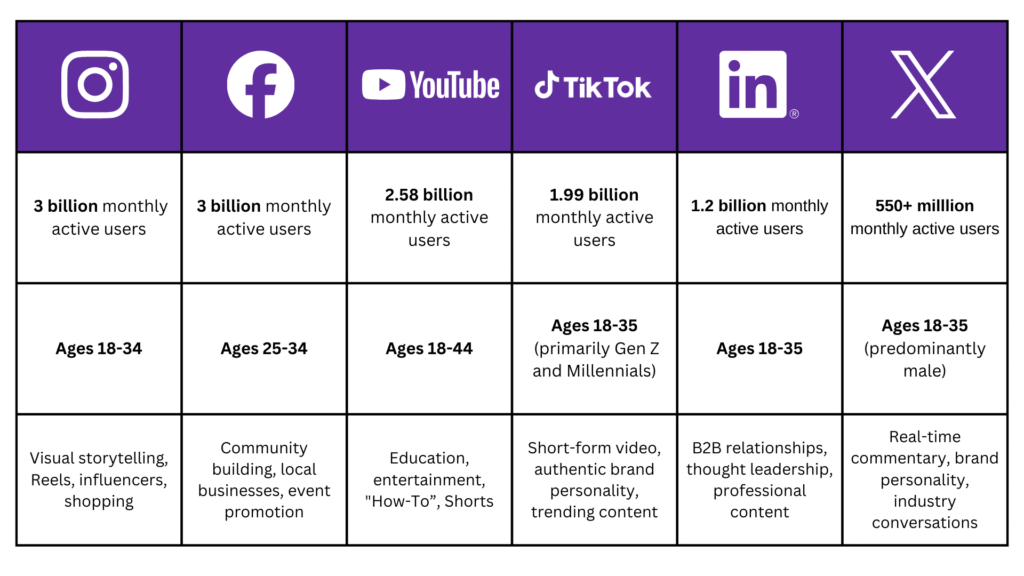
- Instagram (3 billion monthly active users, ages 18–34): Visual storytelling, Reels, influencers, shopping.
- Facebook (3 billion monthly active users, ages 25-34): Community building, local businesses, event promotion
- YouTube (2.58 billion monthly active users, ages 18-44): Education, entertainment, “How-To”, Shorts.
- TikTok (1.99 billion monthly active users, ages 18-35 (primarily Gen Z and Millennials)): Short-form video, authentic brand personality, trending content
- LinkedIn (1.2 billion active users, ages 25-34): B2B relationships, thought leadership, professional content
- X: (550+ million monthly active users, ages 25-34 (Predominantly male)): Real-time commentary, brand personality, industry conversations
You should be posting a minimum of 3-5 times per week across key platforms. If you have the resources and can keep up with producing more content of the same quality, we recommend posting even more than that. Remember that you should never prioritize quantity over quality.
UCE Fine Builders
- Instagram (Primary Platform)
AvantGuard
- LinkedIn (Primary Platform)
- X
Step 4: Build Your Content Pillars
Content pillars are the main themes your social media content is built around. Every post should fit into one of these categories. Content pillars remove guesswork, keep content aligned with business goals, and make planning repeatable instead of reactive.
Why Content Pillars Matter
- Eliminate “what should we post” paralysis
- Keep content focused on what your audience cares about
- Balance value-driven and promotional content
- Make batching, scheduling, and repurposing easier
Identify your content pillars by answering three questions:
- What are your audience’s biggest questions and pain points?
- What unique expertise do you bring to the table?
- What topics align with your business goals?
Most brands perform best with three to five content pillars. With clear content pillars in place, every post serves a purpose. Those pillars can then be adapted across platforms and formats to maximize reach without increasing workload. Adherence to your content pillars will not only help you to reinforce your brand strategy but also make your brand memorable through the consistency of your messaging.
UCE Fine Builders
- Final Project Showcase – “The big reveal”, highlighting completed projects in their entirety
- Behind-the-Scenes – Work in progress, construction process, on-site team expertise, and problem-solving
- Unique Details – Hone in on unique or interesting details of a project
- Services – Sustainable building, architectural concrete, millwork, design, etc
- Client Stories – Showcasing testimonials and satisfied clients
AvantGuard
- C. auris – AvantGuard’s current focus on combatting the critical threat of C. auris with their 3-pronged approach
- Funding & Development – Awards, grants, research partnerships, and media features
- Events – Upcoming and current company events and speaking engagements
- AvantGuard Technology – Detailed insights into AvantGuard’s breakthrough technology and how it differs from competitors
- Thought Leadership – Healthcare trends, research findings, and expert perspectives
- Product Applications – Use cases across hospitals, long-term care facilities, and consumer products
Step 5: Create Content That Works Across Platforms
Strong social media content should be easy to recognize and easy to reuse.
Using branded colors, fonts, and a similar overall visual style helps people quickly recognize your brand as they scroll. Over time, this familiarity builds trust, even before someone reads your caption or clicks a link.
Second, you do not need to create something new for every post on every platform. One strong idea can be shared in different ways. This is called repurposing, and it is one of the simplest ways to stay consistent and avoid burn out.
Brandmark Studios follows a clear repurposing workflow. A single idea is turned into separate posts for each of our targeted platforms. The message stays the same. Only the format changes.
This can only be done successfully if you are not simply copy and pasting the exact post across each platform. Remember that every platform is different. People do not go to TikTok for the same reasons they go to LinkedIn.
This approach helps your best ideas reach more people, keeps messaging aligned across platforms, and makes social media much easier to manage, especially if you are new to it.
UCE Fine Builders

AvantGuard

Step 6: Establish a Posting Schedule You Can Actually Stick To
Consistency matters more than frequency. Algorithms reward regular posting, and your audience learns they can always expect new content from you.
According to HubSpot, only about 19.7 percent of marketers post multiple times per day, with most brands opting to post a few times per week, showing that a consistent weekly cadence is the current standard for effective social media marketing. But this doesn’t mean posting every day if you can’t maintain quality. Determine your realistic posting frequency based on available resources.
A sustainable content schedule might look like:
- 3-5 feed posts per week
- 1-2 reels or video content pieces per week
- Instagram stories 2-3 times per week
- Engagement time: 10-15 minutes daily
We’ve found that content batching and scheduling tools make consistency manageable. Tools like Hootsuite, Later, and Buffer let you create content in focused sessions and schedule it in advance.
The Monthly Planning Workflow
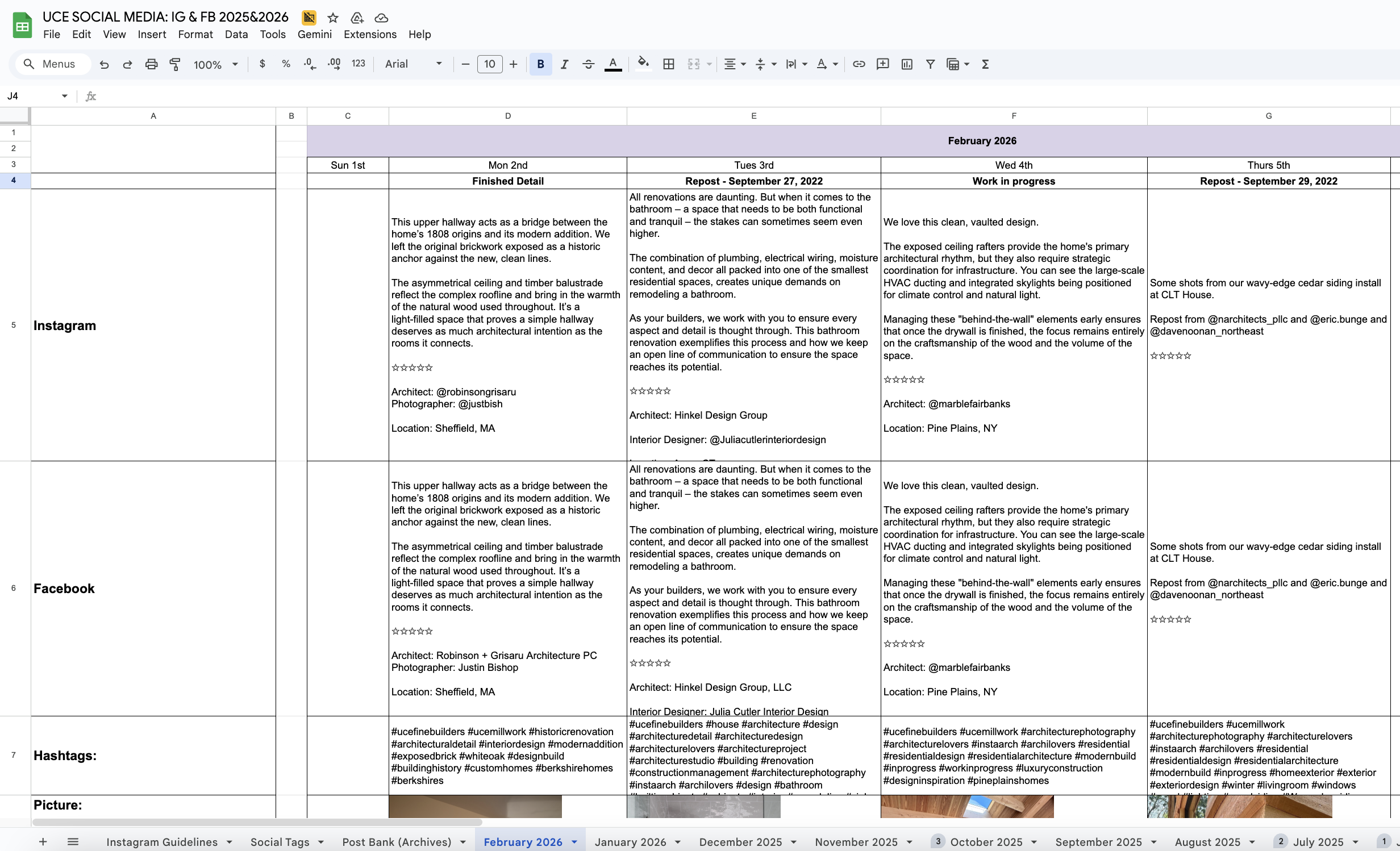
A simple monthly workflow makes consistent posting achievable. We start each month with a kickoff meeting with our social media team to align on themes, goals, and priorities. From there, content is created over the next two weeks, including writing, design, photography, and video. The final week is reserved for review, approvals, and scheduling content ahead of time so the following month is not rushed.
Consistency is not just about posting. Daily community engagement plays an important role, too. Spending just ten to fifteen minutes each day following target audience accounts, responding to comments, and engaging with relevant content helps signal relevance to social platforms and builds real relationships.
UCE Fine Builders
AvantGuard

Step 7: Track Your Results and Adjust Your Strategy
Data tells you what’s working. Intuition tells you what to try next. Use both.
Follower count and likes feel good but rarely correlate with real business results. A smaller, engaged audience beats a large, passive one every time. Match your metrics to your goals from step 1 and track them monthly, looking for trends. Consistent improvement over three to six months indicates real progress.
When and How to Adjust Your Strategy
Review your data monthly and ask:
- Which content types get the most engagement?
- Which topics drive the most meaningful actions (saves, shares, link clicks)?
- What time of day gets the best response?
- Which platforms deliver the best return on investment?
Adjust your strategy based on patterns, not outliers. If educational carousels consistently outperform other content, create more of them. If LinkedIn drives more qualified leads than Instagram, shift resources accordingly.
UCE Fine Builders
- Which content types get the most engagement? → Carousels
- Which topics drive the most meaningful actions? → Work In Progress
- What time of day gets the best response? → 10 am Mon – Fri
- Which platforms deliver the best return on investment? → Instagram
AvantGuard
- Which content types get the most engagement? → Linked Content
- Which topics drive the most meaningful actions? → Educational
- What time of day gets the best response? → 9 am Mon – Fri
- Which platforms deliver the best return on investment? → LinkedIn
Bringing It All Together
The seven-step framework you’ve just learned works across professional services, healthcare, food, retail, home services, and more. The tactics differ, but the strategy remains the same.
For both UCE Fine Builders and AvantGuard, we helped to establish clarity in their goals and target audience, build content around strategic pillars, and perhaps most importantly, we commit to consistency. The results speak for themselves.
Your business may be different from theirs, and that’s the point. This framework adapts to your industry, your audience, and your unique value proposition. If you’ve been posting without a plan, now you have one.
Get Help Building a Social Media Strategy That Actually Works
We offer full social media marketing services and strategy development tailored to your industry and business goals. From content creation to community management to performance tracking, we handle it all so you can focus on running your business. Schedule a free consultation to discuss your social media marketing goals.
FAQs
How long does it take to see results from social media marketing?
Most businesses see measurable improvements in engagement within 30-60 days of implementing a consistent strategy. However, significant business results like increased leads or sales typically take 3-6 months of consistent effort. Social media marketing is a long-term investment, not a quick fix.
Do I need to be on every social media platform?
No. It’s better to excel on one or two platforms than to maintain a mediocre presence on five. Choose platforms based on where your audience spends time and where you can create compelling content consistently.
Should I hire a social media manager or work with an agency?
This depends on your needs and resources. A social media manager works full-time on your business, while an agency brings diverse expertise and handles multiple aspects of your strategy. Agencies often make sense for businesses that need strategic guidance, content creation, and management but can’t justify a full-time hire.
What’s the difference between organic social media and paid social media advertising?
Organic social media refers to content you post without paying for promotion. It reaches people who follow you or discover you naturally. Paid social media advertising uses platform ad tools to promote content to targeted audiences beyond your followers. Most successful strategies combine both.
Can social media marketing actually generate leads and sales for my business?
Yes, but it depends on your strategy and sales cycle. B2B companies often use social media for relationship-building that leads to sales conversations while B2C companies might drive direct purchases. The key is aligning your content and calls-to-action with how your customers actually buy.
What if I don’t have time to create content?
Consider these options: batch-create content monthly, repurpose existing content, work with an agency, hire a part-time social media manager, or use scheduling tools to maximize efficiency. The minimum viable strategy is better than no strategy.
How do I know if my social media marketing is working?
Track metrics aligned with your business goals (not just likes and followers). Monitor website traffic from social, lead inquiries, engagement rates, and ultimately how many customers mention finding you on social media. Review these metrics monthly and look for trends over time.